Why is professional safety lighting essential in businesses and public institutions?
Safety lighting ensures the safe evacuation of people and the protection of property in an emergency. It is required by law in buildings with high human occupancy, complex escape routes or critical infrastructure, and minimises risks in the event of power failure, fire or other hazardous situations.
Which standards and regulations are relevant for emergency lighting in commercial and public buildings?
The following standards apply in particular to planning, installation and operation:
- DIN EN 1838: Lighting requirements for emergency lighting and replacement lighting.
- DIN EN 50172: Operation and maintenance of emergency lighting systems.
- ASR A2.3 and A3.4/7: Requirements for escape routes, emergency exits and emergency lighting in workplaces.
- DIN EN 60598-2-22: Product standard for emergency luminaires.
- DIN VDE 0100-560, 0108: Electrical installationssafety lighting. These standards specify minimum illuminance levels, operating times, positioning and maintenance requirements.
What systems and technologies does PERMALUX offer for the B2B sector?
PERMALUX offers: *
- Central battery systems for the central supply of large building complexes
- Decentralised systems for flexible expansion and redundancy
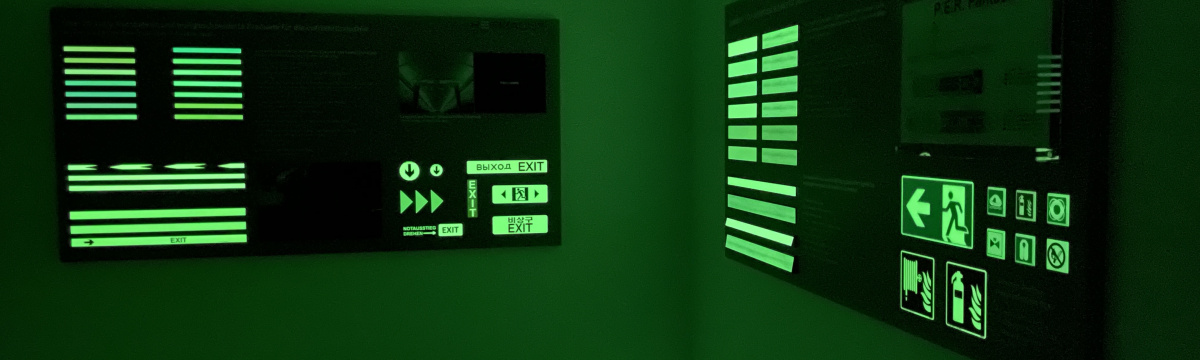
- Dynamic escape route signage and intelligent emergency exit lights
- Customised solutions for industry, healthcare, logistics and public buildings
What requirements apply to the lighting design?
- Escape routes: at least 1 lux illuminance along the centre line
- Open areas: at least 0.5 lux
- Safety signs: must be clearly visible at all times and positioned in accordance with standards
- Colour rendering index: at least Ra 40
- Operating time: generally at least 1 hour, up to 3 hours in sensitive areas
- Uniformity and fast switchover times: required to minimise the risk of tripping and accidents
How is the visibility and effectiveness of emergency signs ensured?
Emergency exit signs must stand out clearly from their surroundings during normal operation and in the event of a power failure. The mounting height and placement are based on the specifications of ASR and DIN EN 1838 to ensure optimum visibility.
How does PERMALUX support companies in planning, implementation and operation?
PERMALUX offers:
- Professional needs analysis and lighting simulation
- Project planning and standard-compliant design
- Installation, commissioning and training
- Maintenance, inspection and 24/7 service
- Support with official approvals and documentation
Which industries benefit most from professional safety lighting solutions?
- Industry and production
- Hospitals and care facilities
- Data centres and IT infrastructure
- Retail, logistics and open-plan offices
- Public buildings and meeting places
Why is regular maintenance of emergency lighting systems, UPS systems and emergency power supply systems so important?
Regular maintenance ensures that such systems function reliably in an emergency. It prevents breakdowns, extends the service life of the systems and, in the case of systems required by building regulations, is a prerequisite for compliance with legal requirements and insurance conditions.
What legal and regulatory requirements apply to maintenance?
The obligation to carry out maintenance arises not only from product-specific standards, but also, in the case of systems required by building regulations, from the building regulations of the federal states and the Workplace Ordinance (ArbStättV).
How often must emergency lighting systems be inspected and maintained?
- Daily: Check operating indicators and control lights.
- Weekly: Functional test of the emergency lighting, including safety signs; documentation in the inspection logbook - goal = ensure the system is generally operational
- Monthly: Functional test with switchover (simulation of power failure); check that all lights switch on, including a visual inspection for damage and a check of the escape route markings. For central battery systems, also check the monitoring equipment. Documentation in the inspection book
- Annually: Complete and comprehensive inspection of all components, including a load test over the rated operating duration. Documentation in the inspection book and preparation of a maintenance report.
- Every 3 years: Measurement of the illuminance of the emergency lighting in according to DIN EN 1838, including documentation. dee
Who is authorised to carry out maintenance on emergency lighting systems?
Maintenance of emergency lighting systems must be carried out by a “specialist in emergency lighting systems”.
What happens if defects are identified during maintenance?
Any major defects identified are documented and must be rectified promptly to ensure the system remains operational. This includes, for example, replacing faulty batteries, repairing control systems or rectifying corrosion damage.
Minor defects are rectified immediately where possible.
How is maintenance work documented?
All inspections and maintenance tasks are documented in a maintenance log and, in some cases, in an inspection logbook. This includes:
- Date, time, scope and results of the inspections
- Details of any repairs or replacements carried out
- Names and signatures of the persons responsible.
How does PERMALUX support your company with maintenance and service?
PERMALUX supports you throughout the entire lifecycle of your system(s) with:
- One-off maintenance assignments
- Maintenance contracts with regular inspection intervals
- Support and assistance with the prescribed expert inspections
- Call-outs to rectify faults and defects
Who is responsible for the installation of emergency lighting systems?
Installation must be carried out exclusively by qualified specialist contractors who are familiar with the applicable standards (e.g. DIN EN 1838, DIN VDE 0100-560/0108) and the specific requirements of the building in question. Professional installation is a prerequisite for operational safety and subsequent approval by the authorities.
What steps does professional installation involve, for example?
- Installation of the power supply (e.g. central battery, individual battery, emergency power supply)
- Mounting of luminaires and signs at the specified positions and heights
- Carrying out the initial inspection and documenting all relevant measurement values and settings
Installation and commissioning are based on the prior planning and lighting design of the emergency lighting system in accordance with DIN EN 1838 and ASR A2.3, as well as on the selection of suitable luminaires and safety signs.
What happens in the event of structural alterations or changes of use in connection with an existing emergency lighting system?
In the event of structural alterations, changes to escape routes or changes of use, the emergency lighting system must be inspected and, if necessary, adapted. This applies to both the positioning and, where applicable, the type of luminaires, as well as the duration of the backup time.
How does PERMALUX support your company in complying with all requirements?
PERMALUX offers:
- Professional planning, installation and commissioning
- Maintenance contracts with regular inspection intervals
- Support with official approvals and inspections
- Training for operating personnel
- Rapid fault rectification and spare parts service